


GENERAL - FAQ
Q: What does Snow Removal mean? Why are piles of snow left in the street?
- “Snow Removal” means the full task of performing all three phases to remove snow from a location (Plowing, Clearing and Hauling) to clear a location of snow as completely as possible within reason.
- “Plowing” means using the blades of city equipment to remove or level some of the snow in a location to create passable lanes for traffic, but not always clearing it to the pavement or creating a windrow; this is generally the first stage of Snow Removal. This stage may sometimes be skipped.
- “Clearing” this is clearing a location of snow down to the pavement level where possible including moving snow into windrows where needed; this is generally the second stage of Snow Removal.
- “Hauling” means the act of moving snow from one location (such as a road or sidewalk or windrow) to a different location; this is generally the third and final step in Snow Removal and often includes using the City’s snowblower to blow snow into trucks to be taken away.
- The pile of snow left in the street during Snow Clearing is called a Windrow. “Windrow” means snow that is temporarily pushed by the City’s equipment to the curb or boulevard or into the center of the road to allow for the passage of vehicles, but does not obstruct traffic flow. Windrows and Hauling of snow will not necessarily follow the Plowing and Clearing priority routes, as equipment availability, timing, and road widths must be taken into consideration.
Q: How does the City determine levels of service standards and priorities?
- The standard of service for snow removal is determined in consideration of the resources and staffing levels available to the City as set out in the annual budget agreed upon by City Council.
Q: What can I do if I don't agree with the way the city does snow removal and would like to see it changed?
- The Snow Removal Bylaw and Policy are set by Council. The levels of service standards for snow removal are determined by Council in consideration of the resources and staffing levels available, and as set out in the annual budget approved by City Council. It is no secret that what people want in terms of levels of service is typically significantly more than what their tax dollars can actually pay for. It is a challenge for Councils to set levels of service in balance with setting property tax rates to do their best to act both fairly and reasonably for the community as a whole. But that doesn't mean that you as a citizen can't ask for change if you feel it is needed. There are a few ways your voice can help shape the decisions of Council when it comes to setting budget, levels of service standards and making changes to regulations.
- Ensure that when the city does do public engagement on the topic of snow removal that you participate and encourage others to do the same. Visit our engagement site and register, then subscribe to the Snow Removal project so you can receive updates on when we do more engagement on this topic.
- Consider reading the document called A Citizen's Guide to Shaping Council Decisions available doe download here https://pubsaskdev.blob.core.windows.net/pubsask-prod/104661/104661-2017-Citizens-Guide-To-Shaping-Council-Decisions.pdf.
- If you're planning to write to Council to make a specific request or ask that they take action on a matter, please review the FAQ and information on our website for how to shape your request: Council Meetings & Requests. Please be aware that, for the most part, correspondence and requests sent to Mayor & Council are public information as they are generally presented to Council at a public meeting.
- You also have a voice in who represents you and the community as a member of Council. The next election is in 2024. Consider running for Council yourself or nominate someone you think would serve the community well. Mostly importantly make sure you get out and vote in the election. Representation matters. Every vote makes a difference.
- Ensure that when the city does do public engagement on the topic of snow removal that you participate and encourage others to do the same. Visit our engagement site and register, then subscribe to the Snow Removal project so you can receive updates on when we do more engagement on this topic.
Q: What sort of timeline is "following a snow event"?
- When a timeline begins “following a snow event”, this means that the timer starts when the snow stops falling. If the snow is falling continuously for multiple days, some work to keep routes reasonably clear may be performed before the snow has completely stopped, especially for emergency services in terms of roads, or for sidewalks to prevent it from becoming too packed down due to foot traffic.
Q: I have flower pots, a driveway ramp, and other landscaping items that are in my yard but on City property. Will they be safe during Snow Removal?
- The City only permits non-permanent items to be placed AT YOUR OWN RISK on the road allowance that you use as part of your yard between October 1 - April 1 in each year, subject to enforcement. The City is not responsible for damage to any permanent or non-permanent items placed on City property. We also recommend clearly flagging any permanent items so they can be easily seen by our equipment operators.
Q: Where do I put the snow I'm clearing from my driveway?
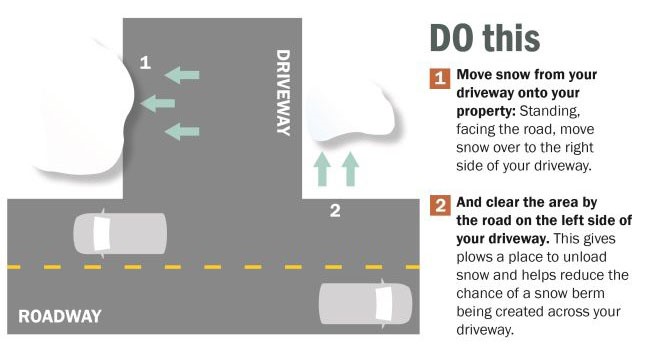
The snow you remove from your driveway needs to remain on your property. Do not push snow into the road, you may receive a ticket or order to remedy if you push snow into city roads. Clear snow effectively from your driveway to reduce the chance of a snow berm being created when your road is cleared.
Q: Where do I put the snow I'm clearing from the sidewalk?
- Any snow removed off the sidewalk is to be placed on the owner’s adjacent private property. However, if placing snow on your own property is impractical, you may place the snow or ice or other loose debris from the sidewalk in the boulevard or roadway adjacent to the sidewalk, but must do so in a manner that does not create a hazard or interfere with the use of the roadway or cover storm drains or cause difficulty for those parking on the road.